




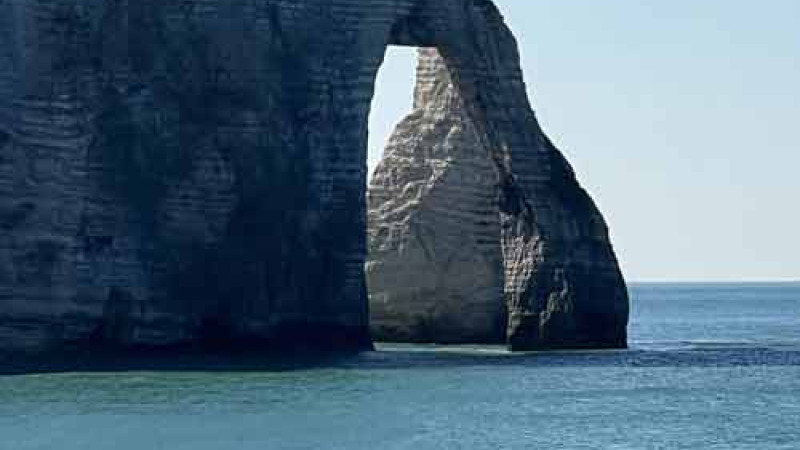
Honfleur and the Cliffs of Étretat
-Honfleur looks so utterly enchanting, it is hard to remember that it was built essentially for commerce. Its harbor sits in a great location, tucked away on the southern side of the Seine’s estuary. This was created in 1668 by Duquesne under orders from Colbert as a defensive measure and was mostly involved in exports to England during the Hundred Years War. The French king had this strategic spot fortified. Through the Ancient Regime, Honfleur’s ship owners made fortunes from trade, notably with North America.
Samuel de Champlain, one of the most famous explorers associated with the port, headed off to found the Canadian city of Quebec. With their fortunes, wealthy Honfleur families built their high-rise homes, packed tight next to each other, especially around the heart of the port, where front-row homes overlooking the vessels was a distinct privilege.
Honfleur attracted the special quality of light by the estuary; painters started coming to Honfleur in the 18th century. But it’s really the beginning of the 19th century, between 1810 and 1820, that they came to Honfleur and discovered the romantic setting of the medieval town. The most famous painter to come here was Claude Monet.
We saw a building where salt was stored. The building was a large brick building. We all thought it was first used as a jail. Louis the 14th paid his soldiers part of their salary in a bag of salt, which they could either trade or sell to get whatever their necessities were.
The town was not bombed during World War II. The German army sent their soldiers for their R&R to the town of Honfleur.
The town still has cobblestone streets and buildings from the Middle Ages. The houses, of course, have been modernized and now have electricity and indoor plumbing.
Bob and I took an optional tour to the Cliffs of Étretat. This was another beautiful French town that still has the feel of the Middle Ages. The housing is beautiful and maintained, the streets of cobblestone. The cliffs are breathtakingly beautiful against the blue water. Once again, another French village that attracted the impressionist artists.
I climbed one of the highest points in the town to see the memorial “The White Bird” which was erected on the top of the cliffs to mark the last place the white airplane was seen. In 1927, a pair of French World War I heroes attempted to make the first nonstop flight from Paris to New York City, but the plane mysteriously disappeared somewhere over the Atlantic never to be seen again.
I found the monument disappointing to these two heroes of the Great War and their attempt to cross the Atlantic Ocean. It is very simple. There are no signs on the monument. When I climbed down the cliff and went into the village I asked the store owners if they have a postcard of the monument or magnet. I was told no. I think France is doing a disservice to these heroes.
This town did not suffer a lot of damage during World War II. If the village or town suffered bombing, with help from the Marshall Plan, the housing that was rebuilt was quick but not as beautiful as the buildings that were destroyed. France had a homeless population and they needed to get them in housing as quick as possible.
Today is our last day on the ship; tomorrow we will return to Paris.
Leave a comment